



search
date/time

Tue, 7:00PM
broken clouds
19.2°C
SW 6mph
broken clouds
19.2°C
SW 6mph
 | Sunrise | 4:05AM |
| Sunset | 8:28PM |  |
P.ublished 15th February 2025
arts
In Conversation: Aaron Parsons on RSC First Encounters – The Tempest
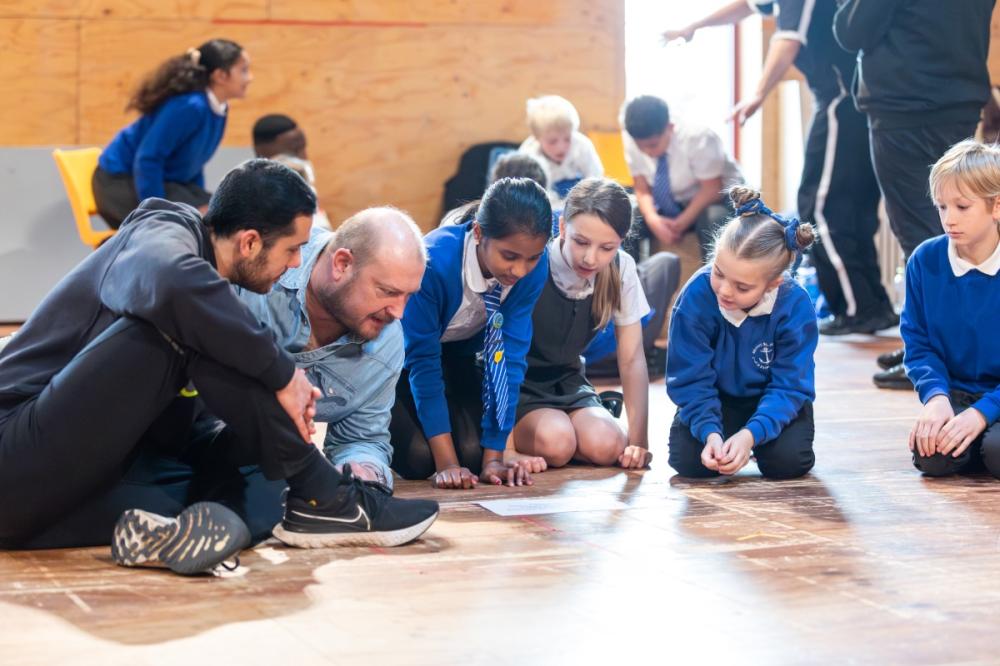
First Encounters workshops The Tempest
Photo: Sara Beaumont ©
I don’t come from a theatrical background and grew up working class in Bristol. The turning point came at school when a visionary science teacher, Vic Ecclestone, encouraged me to join his all-boys dance company, the Hartcliffe Boys Dance Company. At the time, the idea of getting a group of boys from a council estate dancing was unheard of but he believed passionately in the potential of young people and that circumstances shouldn’t determine whether you had access to things like the arts. His influence was transformational and without him my life would probably have taken a different path. He planted a seed so that when a theatre company performed at our school, it didn’t seem impossible to imagine myself in that world.
With Vic’s support and encouragement, I finished school, went on to university and got a masters in directing from Bristol Old Vic Theatre School. After a stint running a youth theatre and working as a producer and a freelance director, my first job combining all of those skills was as the Associate Director at Prime Theatre in Swindon. Since then, I’ve worked on a number of shows for the RSC as well as with teachers and young people all over the country as part of their Creative Learning output. The Tempest will be my seventh production for the RSC.
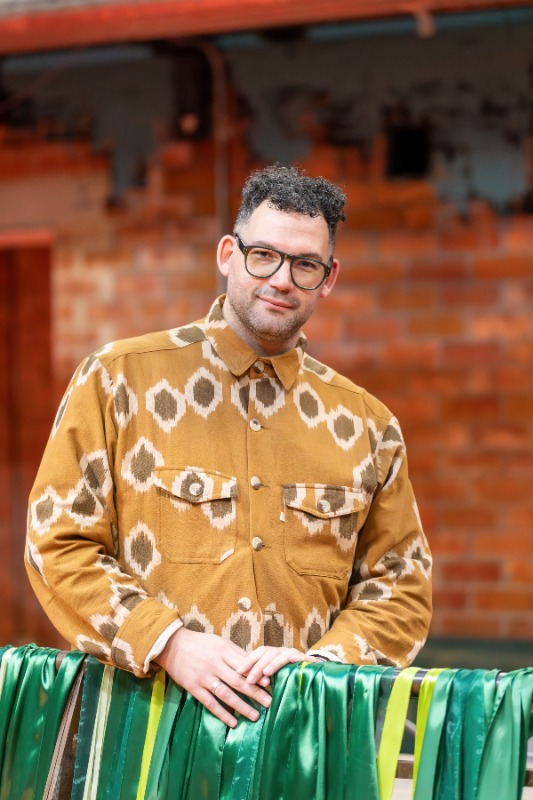
Aaron Parsons
Photo: Sara Beaumont ©
For lots of people, First Encounters shows are their first experience of theatre and/or Shakespeare, so we want them to feel welcomed into another world as soon as they enter the space, like we’ve ‘taken over’. One way we’ll do this is by using familiar drama devices and motifs like costumes, masks and movement but presented in new, unexpected ways. We’ve also used colour and texture to create a vibrant but tactile set that invites audiences into the action and fires imaginations from the outset. The centrepiece is a large, green ‘mound’ reminiscent of most people’s idea of a desert island and behind are rows of fabric strips suspended from retractable arms – sort of abstract island trees – that can be extended or reduced depending on the venue.
Magic and the mysterious ‘noises’ of the island are recurring themes in The Tempest, and we’ll use music and sound to help us create an ‘other-worldly’ atmosphere. Sound will come from different directions, at unpredictable moments and using amplifiers, a magical soundscape will feel like it’s wrapping around and holding the audience, echoing the omnipresence of the island’s magic. The Tempest is one of Shakespeare’s most musical plays and our composer, Jack, has created some beautiful, original music to accompany Shakespeare’s original lyrics.
How do you think The Tempest will resonate with young audiences today?
The play deals with a lot of complex issues like enslavement and colonialism that are often presented in a reductive, simplistic way. But young people are extraordinarily perceptive. We did a series of research and development sessions working with young people before going into rehearsals and one of the things that came up consistently was their understanding of injustice, particularly in relation to the treatment of Caliban and Ariel. Young people constantly questioned why Caliban and Ariel aren’t given a proper ending in the play. We’ve tried to address that through the editing process so that both characters get an ending or at least some agency and say over what happens next.
For young people I think Ariel is also interesting as a character that transcends gender. The actor who plays Ariel is non-binary so that representation on stage in itself is really important - especially if there are people in the audience looking to feel represented or questioning their own identity.
The play also deals a lot with family relationships and the connections between parents and children which will resonate strongly with lots of members of our audiences. If in a small way it helps reduce isolation, foster greater empathy or just opens up some conversations, then that’s a positive thing.
Were you looking for specific qualities when you were casting actors for the show?
People naturally make assumptions about the Royal Shakespeare Company, so we were very clear from the start that this was going to be a very different kind of job. We were looking for actors that either had experience of working with young people or were close enough in age to connect with our younger audiences. It takes a very specific mindset to work together as part of such a small company, away from home and travelling from place to place for 12 weeks. We needed team-players and collaborators who wanted to be part of an ensemble, but we also needed people who really believed in the importance of taking the work out into communities and schools. It’s an intense but extremely rewarding experience for the cast and creatives, so I was also looking for kindness and empathy.
The Tempest is a multifaceted play and to be the stewards of so many people’s first encounters with Shakespeare or the theatre is a responsibility that we take extremely seriously. To communicate that complexity to young and first-time audiences requires not only a deep understanding of the play but a level of personal integrity and compassion to do it sensitively and clearly. I’m happy to say we’ve more than fulfilled that brief.
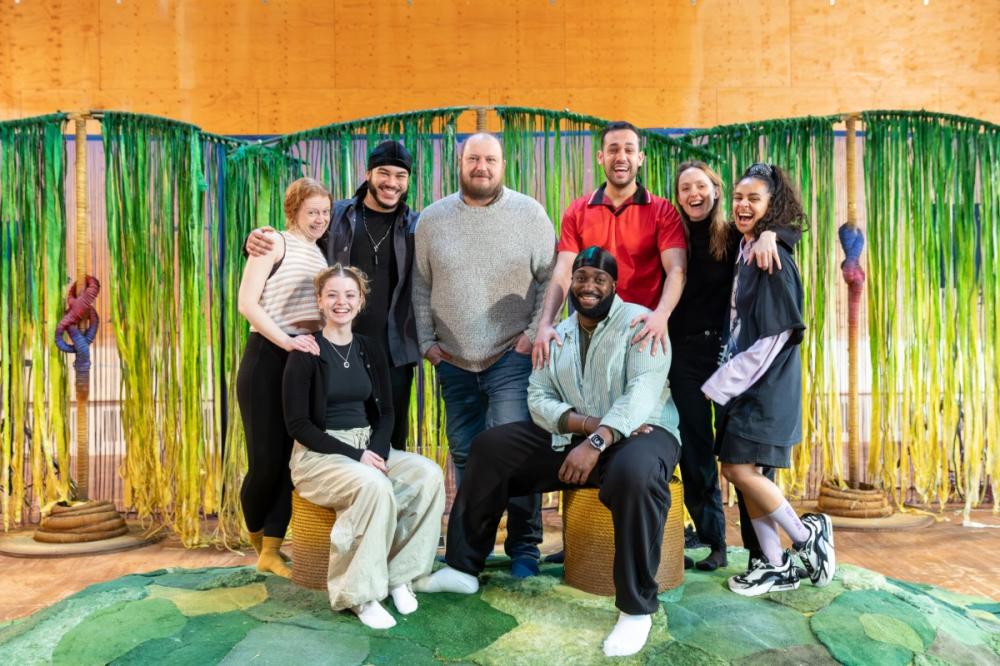
First Encounters Tempest Cast members
Photo: Sara Beaumont ©
There’s still an unconscious bias in this country that if you ‘get’ Shakespeare you’re clever and if you don’t, the subtext is that you’re not. The only way to tackle that is by making shows well, making them entertaining and making them accessible. Retaining the original language and not patronising audiences by removing it because you assume they won’t get it, is an important part of that. That and seeing the language brought to life through live performance. Shakespeare’s plays were written to be seen in performance so when a production is done well, with actors who have a profound understanding of the play, that gets communicated both verbally and non-verbally in performance.
We do also think about how visuals and audio can help make the story-telling clearer and how we can prepare audiences in advance of seeing the show. But we don’t want that to be a militant process, we want it to happen organically. Theatres are called houses for a reason, and we’re inviting audiences to step into our world, our home, and be held, be entertained and just soak up the action, atmosphere and experience.
What interests you about creating theatre for younger audiences and why do you think it’s often taken less seriously than theatre aimed at adult audiences?
It’s arguably the most important work that arts organisations and theatres do. All the cuts and barriers to accessing the arts and creativity mean that outreach work like this is more vital now than ever before.
Without it, so many young people will never be exposed to the arts and may never discover their creative potential. That’s certainly true of my own experience where a trailblazing science teacher and a visit from Travelling Light Theatre to my school literally changed the trajectory of my life.
I do think that theatre made for young people lacks the recognition it deserves. I think in the UK it’s linked to status - a hangover from the past which is unfortunately still prevalent in theatre. The reality is that rehearsing and producing a show for young people is no different to any other rehearsal process, but the prevailing attitude for a long time has been that theatre aimed at children and families is simplistic, and all has the tone of panto.
It’s not the same in other countries in Europe or with other mediums like film or music where the level of skill and sophistication is fully acknowledged. I think for a long time, it was partly attitudes and partly due to the fact there were no dedicated spaces for young people’s theatre. But on the plus side, we are starting to see a shift and in recent years there’s been some extraordinary, high-quality work being made specifically for children and young people.
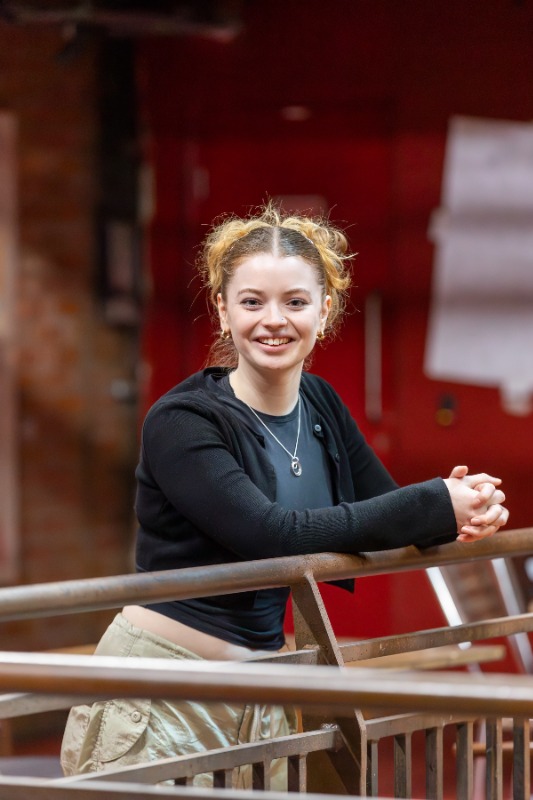
Scout Worsley
Photo: Sara Beaumont ©
Like The Tempest’s ‘brave new world’, I hope the experience will open up new perspectives and new possibility. Good theatre should prompt as many questions as it provides answers, so I hope it stimulates debate, sparks conversation and gives people permission to ask questions.
Shakespeare wrote The Tempest at a time that foreshadows the empire and where racial identities were taking shape. Topics like enslavement and colonialism are still presented through a very particular prism, so I hope people will leave having opened their minds to the importance of considering broader perspectives and discussion at a time in history where change and uncertainty threaten to polarise opinion. I think a lot of people will be surprised by just how resonant the play’s themes and subject matter is today, drawing parallels between the play and what’s going on in our own world. If we can entertain as well as get people thinking and talking, then we’ll consider it a job well done.