


search
date/time

Sat, 10:00AM
light rain
8.7°C
S 15mph
light rain
8.7°C
S 15mph
 | Sunrise | 6:55AM |
| Sunset | 4:54PM |  |
P.ublished 24th October 2026
business
From Power Station To Data Centre: The Carbon Story Hidden Beneath Skelton Grange
Dr Nathan Wood, Dr Aaron Yeardley – Tunley Environmental
But before a single server rack arrives, a huge and largely invisible job must happen first, safely bringing decades-dead industrial land back into productive use. That’s where Howard Civil Engineering comes in as principal contractor for the earthworks, demolition, remediation and infrastructure. It is here, in the ground, that some of the most important sustainability decisions on the entire project are being made.
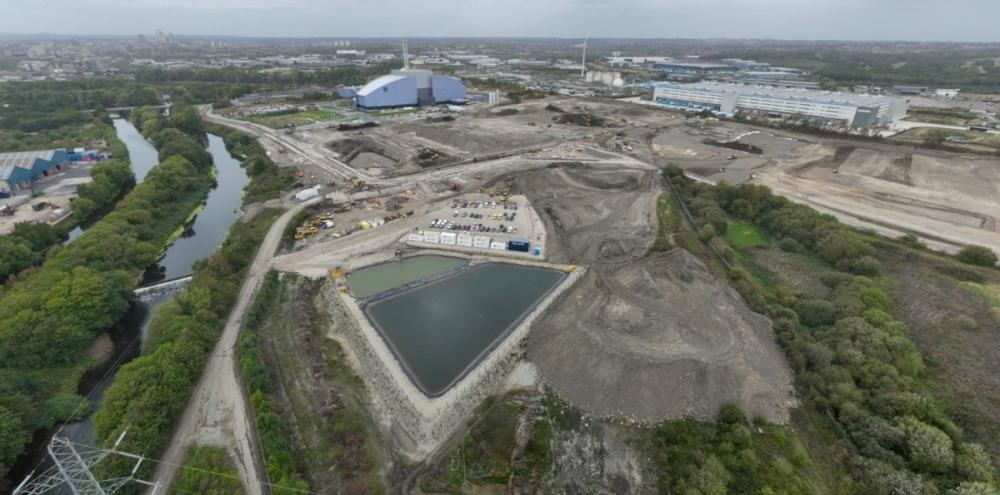
Aerial view of Skelton Grange, with lined water treatment lagoons in the foreground supporting groundwater management and reuse during the site’s redevelopment. Drone image courtesy of George Bagnall.
| Brownfield land reclaimed 48 acres | Groundwater treated on site 100,000+ m³ | Turbine basement demolished 130Ã80Ã12 m |
Three Practices Cutting Environmental Impact Before the First Brick
| Concrete Recycling ~19 kg CO2e saved per tonne reused on site At 10,000 t: ~189 t CO2e avoided Equivalent to taking 44 cars off the road for a year. One waste stream, 3 products (6F2, 6A, Type 1). | Water reuse 100,000+ m3 treated & responsibly discharged Closed-loop lagoon system reused for drilling, grouting & dust suppression, cutting mains and tanker demand, protecting flows in the River Aire. | Steel recovery structural steel recovered Segregated during demolition and sent to certified recyclers for lower-energy secondary steel - less virgin ore, less mining impact. |
*Figures are estimates based on recognised industry databases (e.g. ICE, DESNZ, OneClick LCA) investigated by Tunley Environmental
The Part Nobody Sees
Reusing brownfield land can help reduce the need to develop greenfield sites and may support the protection of existing natural habitats. Where appropriate remediation and design measures are in place, brownfield redevelopment can contribute to a more responsible use of land and resources.
The catch is that unlocking that land is carbon-intensive work. Deep excavation, demolition, dewatering, moving thousands of tonnes of material. All of it generates emissions long before anything is built on top. On a legacy site like Skelton Grange, the challenge is bigger still: buried basements, deep made ground, old mine workings, sludge beds and localised contamination all have to be dealt with. One single operation here involved demolishing a turbine basement roughly 130 m long, 80 m wide and 12 m deep.
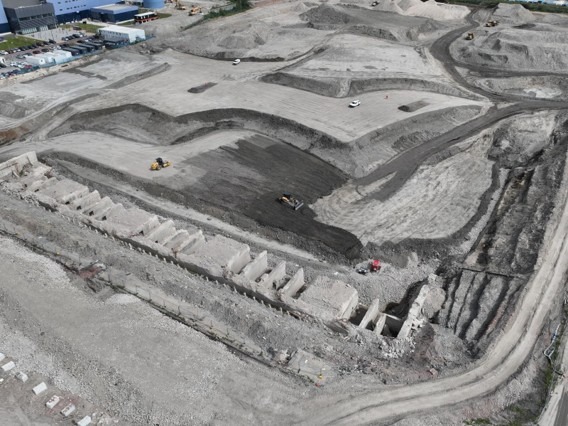
Aerial view of ongoing earthworks at Skelton Grange, showing exposed concrete structures from the former power station as Howard Civil Engineering prepares the site for redevelopment. Drone image courtesy of George Bagnall.
1. Concrete that Never Leaves Site
Demolition produces enormous volumes of old concrete. The standard approach is to truck it off to a recycling centre or landfill, then truck virgin aggregate back in from a quarry, a carbon and cost on both journeys.
Howard Civil does the opposite. A mobile crusher processes the concrete on site, turning one waste stream into three usable products (6F2, 6A and Type 1) that go straight back into site roads, drainage and sub-base, this means that very little leaves site.
The saving is estimated at around 19 kg of CO2e per tonne of material reused. Scale that up and it adds up fast: at 10,000 tonnes, that’s roughly 189 tonnes of CO2e avoided. This is roughly equivalent to the same as taking 44 cars off the road for a year. It also means less quarrying, fewer HGVs on local roads, and less landfill.
2. Water that works twice
Groundwater is one of the defining challenges on brownfield sites, both because legacy contamination has to be contained, and because construction itself is thirsty.
Rather than pumping and dumping, Howard Civil runs a closed-loop lagoon system. Water is drawn from the old basement voids, cleaned through sediment removal, aeration and settlement in lined lagoons, then continuously tested against Environment Agency standards before any controlled discharge to the River Aire. So far, over 100,000 m³ of groundwater has been treated this way.
Crucially, treated water is reused on site for drilling, grouting and dust suppression, cutting the need for mains water and tanker deliveries, and helping protect flows in the Aire catchment.
3. Steel that Stays in the Loop
On some brownfield sites, buried metalwork and other below-ground obstructions may remain from previous industrial or commercial uses. Where such materials are left unmanaged, corrosion or associated coatings may contribute to localised ground-quality risks.
Howard Civil segregates structural steel during demolition and sends it to certified recyclers, feeding lower-energy secondary steel production rather than virgin manufacturing. Timber and other metals are sorted for reuse too, keeping material out of landfill and in circulation.

Dr Aaron Yeardley

Dr Nathan Wood
Some of the environmental benefits created during enabling works are difficult to capture through standard company carbon reporting. Fuel use, purchased materials and waste are usually recorded, but the benefits of reusing materials, reducing transport and avoiding new resources can be less visible.
Tunley Environmental has worked with Howard Civil Engineering to assess these project benefits using site data. This includes reviewing how much concrete has been reused, how water has been treated and used again, and where recovered materials have been sent.
The assessment compares the approach taken at Skelton Grange with what may otherwise have happened, such as removing concrete from site and importing virgin aggregate. This helps Howard Civil understand where its site practices have reduced waste, transport movements, resource use and associated carbon emissions.
The work provides Howard Civil with a clearer evidence base for client reporting, future tenders and strategy on other projects. It also helps identify which practical actions deliver the greatest environmental benefit and where better site data could support more accurate measurement in future.
For more information click here.
The shortened address for this article is: newspub.uk/121f4