



search
date/time

Sun, 3:00PM
overcast clouds
10.1°C
SSE 4mph
overcast clouds
10.1°C
SSE 4mph
 | Sunrise | 6:43AM |
| Sunset | 6:00PM |  |

Andrew Palmer
Group Editor
P.ublished 7th March 2026
arts
Review
Classical Music: Mozart: Piano Concertos, Vol. 12
A journey's end
Overture to ‘Idomeneo, rè di Creta’, K. 366; Rondo in A major, K. 386
Concerto in F major (three pianos), K. 242 ‘Lodron’; Rondo in D major, K. 382; Overture to ‘La finta semplice’, K. 51; Concerto in E flat major (two pianos), K. 365
Jean-Efflam Bavouzet, Andrea Nemecz, Rose McLachlan; Manchester Camerata/Gábor Takács-Nagy
Chandos CHAN 20339
chandos.net
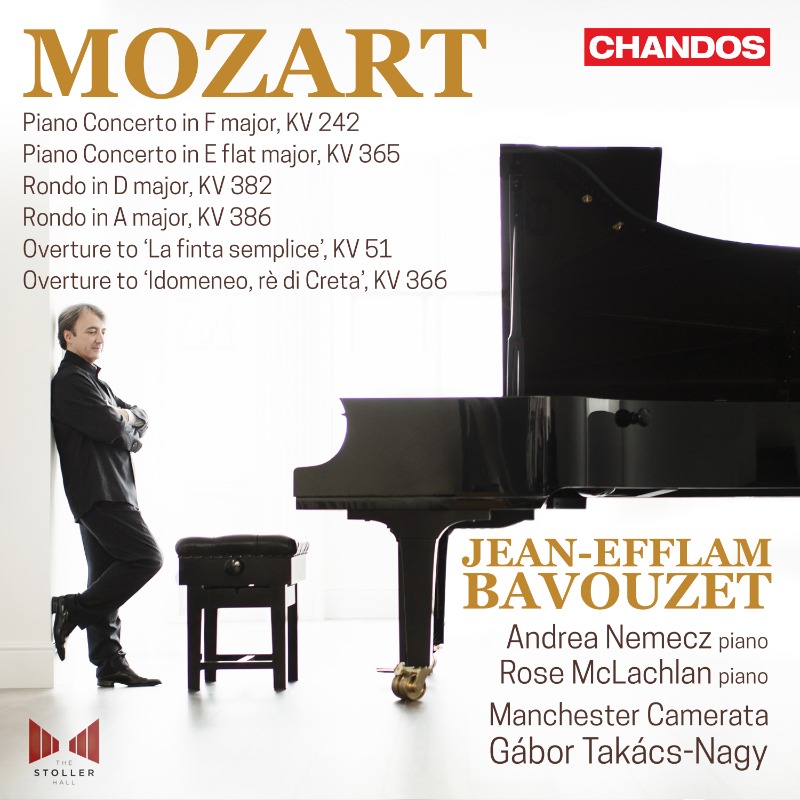
The pianist himself puts it with characteristic grace: the sense of fulfilment at reaching one's goal, he writes, "always blends with an immediate sense of nostalgia for the recording sessions, marvellous moments engaged in the search for a truth that always remains beyond reach."
The programme is admirably conceived. Two operatic overtures — from Idomeneo and La finta semplice — frame the A major and D major Rondos, while the concerto for three pianos and the double piano concerto complete a disc that feels both intimate and celebratory.
Bavouzet plays a modern Yamaha CFX, recorded with natural warmth in Stoller Hall, and all the qualities that have distinguished this series remain fully intact: the articulation is immaculate, phrasing suitably elastic, ornamentation worn with effortless charm. Crucially, the music is given room to unfold. Gábor Takács-Nagy draws from Manchester Camerata an accompaniment that is lean and luminous — never crowding the soloist, always leaving the melodic lines space to sing.
The Concerto KV 242 brings Bavouzet together with his wife Andrea Nemecz and Rose McLachlan, and the chemistry between the trio is immediately tangible. This is chamber music thinking applied to a concerto framework: each pianist listens intently to the others, the detail precisely observed, the interplay easy and unforced. Beautiful phrasing and a shared sense of pacing mean that every phrase is allowed its natural weight — nothing pushed, nothing withheld.
Nemecz returns for the Double Concerto K365 and the conversational freshness is just as striking. The two pianists trade ideas with the sheer pleasure of musicians who know each other's minds, the exchange crisp and spontaneous. The Rondeau that brings the disc to its close is nimble and light-footed — an ideal valediction, its wit undimmed to the very last bar.
The overtures give Manchester Camerata their own moment in the spotlight, and they take it with distinction. The Idomeneo Overture moves with well-judged momentum and clean ensemble, while La finta semplice is dispatched with equal neatness — brief interludes that remind us how finely attuned this orchestra has become to the idiom across the span of the series.
A worthy conclusion to an outstanding cycle.
Also by Andrew Palmer...
Oktoberfest: The Dream, The Drench, And The DetourClassical Music: Hallé - Huw WatkinsClassical Music Sonority Jan Liebermann — OrganClassical Music: Nikolaus Harnoncourt --Mendelssohn, Wagner & SchumannSpring Statement: Business Leaders Warn Of Fragile Growth Outlook As Middle East Crisis Casts Shadow