search
date/time
 | Lancashire Times A Voice of the Free Press |

Andrew Palmer
Group Editor
P.ublished 24th January 2026
arts
Review
Classical Music: Listen. It is Here
We have not long to love; Poems of the Sky; To The Old Gods; Songs for A; Seven Portraits; O ignis Spiritus Paracliti; The Prize Song of Taliesin; I want to be a cow; Two Vedic Hymns; Arise, my love; To the place of trumpets.
Helen Charlston (mezzo-soprano), Alexander Chance (countertenor), Harriet Burns (soprano), Elgan Llyr Thomas (tenor) with Edward Picton-Turbervill (piano)
Delphian DCD 34345
https://www.delphianrecords.com/
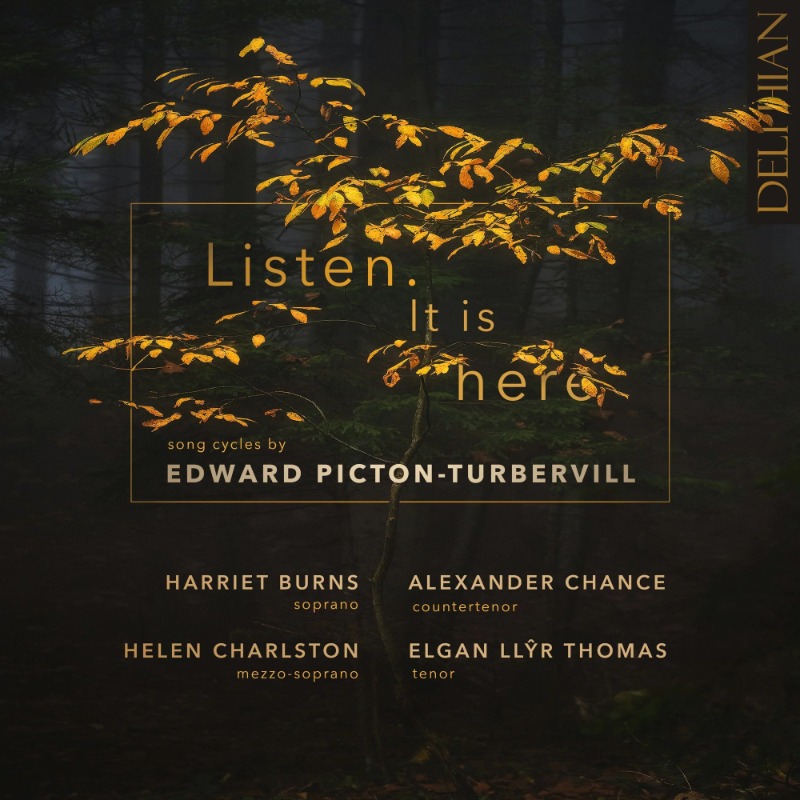
Helen Charlston's mezzo-soprano proves captivating throughout, whilst the quintet of performers assembled here – each a compelling artist in their own right – demonstrate the composer's instinct for matching voice to text. Picton-Turbervill's piano writing, which he performs himself with considerable skill, forms an integral part of the musical argument rather than mere accompaniment.
These songs emerged from a concentrated two-year period following Picton-Turbervill's return to composition, and they bear the hallmarks of creative urgency tempered by craft. The writing balances emotional immediacy with formal discipline – each song is beautifully shaped to capture its text's essence, yet never at the expense of musical coherence.
Hildegard's O ignis Spiritus Paracliti receives an atmospheric reading from Harriet Burns, her voice ideally suited to the music's mystical intensity. Here, as throughout, the piano's role proves crucial—Picton-Turberville understands the instrument's capacity for colour and knows when to support and when to lead.
Alexander Chance brings his countertenor's characteristic purity to To the Old Gods – a voice of remarkable beauty and technical assurance, its interval leaps executed with the kind of accuracy that recalls Emma Kirby's legendary precision. The timbre possesses an otherworldly quality perfectly suited to the text's invocation of ancient divinities.
Songs for A sets five minuscule yet emotionally overwhelming poems that Harold Pinter addressed to his wife, Antonia Fraser. Llŷr Thomas's strong tenor proves well suited to their intimate intensity, his voice beautifully controlled, his dynamics exquisitely judged. The brevity of each poem only heightens their emotional impact – Picton-Turbervill understanding that Pinter's spare language requires music of equal restraint.
The seven brief piano miniatures, Seven Portraits, honour close friendships through music of considerable charm. Beautifully phrased and quite mesmerising, they demonstrate Picton-Turbervill's ability to distil character into sound, each portrait a miniature world complete in itself.
Tim Watts's programme notes speak of "brevity as essential to the notion of the song as a fleeting glimpse of mysteries too big and too mysterious to grasp for more than a moment."
This insight illuminates much of what makes these settings compelling. The bittersweet Tennessee Williams text, We Have Not Long to Love, captures precisely this transience – the moment of human love celebrated even as it slips away, too soon passed.
Both Poems of the Sky and To the Place of Trumpets – the latter another substantial 'megasong' – express deep longing for lost wholeness. Rilke expresses a yearning to avoid feeling "separated, shut off from the starry dimensions by so thin a wall." Both settings conclude with the contemplation of liberating surrender, depicted through the simple act of lying down in flowers or grass – images of release and return that Picton-Turbervill sets with touching simplicity.
Throughout, the performances combine warmth with technical polish, each singer bringing emotional intelligence to their material. The recording, in typical Delphian fashion, captures both the intimacy of the songs and the space around them, allowing Picton-Turbervill's writing its full effect.
This disc is a bold declaration of intent from a compelling new voice in British song – a composer who believes, without embarrassment, in music's power to move, comfort and connect.
Those seeking a contemporary song that speaks with sincerity and stylistic clarity will find much to treasure here. Listen, indeed. It is here.